

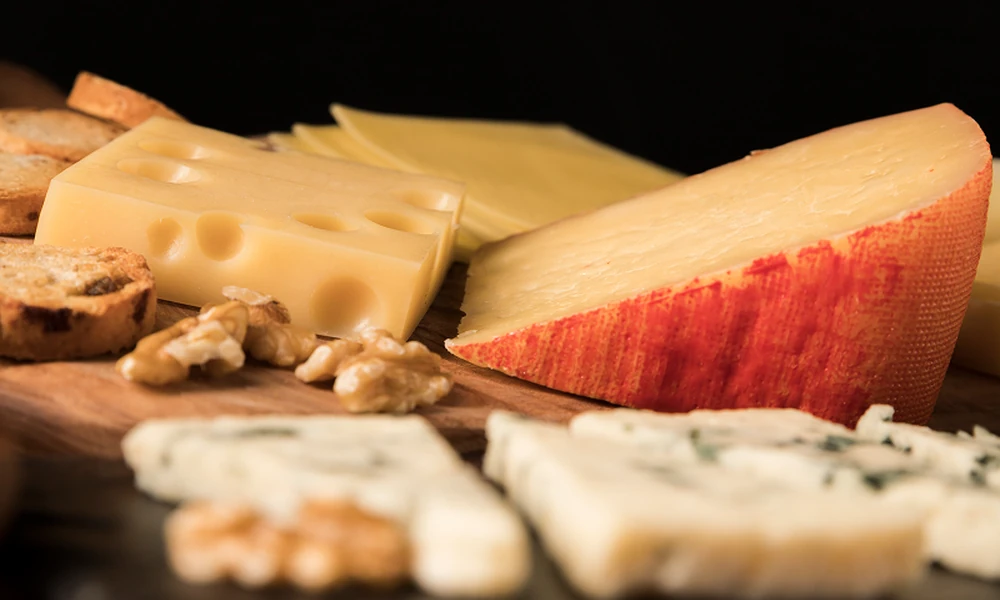
A cheese rind is more than an outer surface. Depending on the style, it can provide clues about how the cheese was matured, which microorganisms were encouraged on its surface, and whether protective materials were used during ageing.
Understanding rind types can therefore help explain differences between cheeses found at a cheese shop. Natural, bloomy, clothbound and coated rinds each result from different production and maturation practices.
What Is a Cheese Rind and How Does It Form?
A cheese rind is the outer layer that develops or is created around certain cheeses. Its formation usually takes place during maturation, when the cheese is stored under controlled conditions of temperature and humidity.
Not every cheese develops the same type of rind. Some form naturally as their surfaces dry, while others are deliberately treated with mould cultures, wrapped in cloth or covered with protective coatings.
Factors that can influence rind development include:
- Moisture: Water gradually moves from the cheese towards its surface and can evaporate during ageing.
- Humidity: The humidity of the ageing environment influences how quickly the surface dries.
- Microorganisms: Moulds, yeasts and bacteria may contribute to the development of particular rind types.
- Surface treatment: Cheesemakers may brush, wash, turn or otherwise care for cheeses as they mature.
- Ageing time: The rind and the cheese beneath it can continue to change throughout maturation.
Some cheeses have little or no developed rind because they are eaten fresh or packaged in ways that limit surface drying. The veins in blue cheese, meanwhile, are produced by mould growing within the cheese rather than simply forming an external rind.
The rind therefore provides an initial indication of what happened to a cheese after its curds were formed and shaped.
What Can a Natural Rind Tell You About How a Cheese Was Made?
A natural rind forms without an artificial outer coating. As the cheese ages, its exposed surface loses moisture and becomes firmer, creating a boundary between the interior and the ageing environment.
Cheesemakers still manage this process carefully. Depending on the cheese, wheels may be turned, brushed or rubbed during maturation, while temperature and humidity are controlled to support the intended development.
A natural rind may provide several clues about production:
- A dry, firm surface can indicate that the cheese experienced moisture loss during extended maturation.
- Variations in texture may result from the microorganisms growing naturally or deliberately on the surface.
- Changes in rind thickness can reflect factors such as ageing conditions, moisture and cheese style.
- Surface markings can sometimes result from the moulds, mats, shelves or other materials used during production and ageing.
Rind appearance alone cannot establish the precise age or production method of a cheese. Cheesemaking practices differ considerably, so information from the producer or a knowledgeable cheese shop provides important context.
Overall, a natural rind indicates that the cheese’s exterior has developed as part of the maturation process rather than being completely sealed beneath an artificial coating.
What Does a Bloomy Rind Reveal About the Cheesemaking Process?
Bloomy-rind cheeses are recognised by a soft, usually white exterior created by surface mould. Cheesemakers commonly introduce selected mould cultures, including species of Penicillium, to encourage this characteristic rind.
The mould grows across the outside of the cheese during maturation. Its activity contributes to changes in the cheese immediately beneath the rind, helping break down proteins and fats as the cheese ripens.
This process can result in:
- A white or off-white surface.
- A soft rind that develops as mould covers the cheese.
- Ripening that progresses from the exterior towards the centre.
- Changes in texture and flavour as maturation continues.
The mould used for a bloomy rind serves a different purpose from the internal mould associated with blue cheese. In blue cheeses, mould growth is encouraged inside the cheese, often with piercing used to introduce oxygen needed for mould development.
A bloomy rind therefore indicates deliberate surface-ripening techniques and provides a visible sign of microbial activity during maturation.
What Can Clothbound and Coated Rinds Tell You About Cheese Production?
Not every cheese relies on an exposed rind. Cheesemakers can use cloth, wax or other approved coatings to protect the surface and influence moisture loss during ageing.
Clothbound cheeses are wrapped in fabric, often with fat applied to help the cloth adhere to the surface. The covering can allow controlled moisture loss while protecting the cheese as it matures.
Coated cheeses follow a different approach:
- Wax coatings create a protective barrier around the cheese.
- Plastic or polymer coatings may be used to control moisture loss and protect the surface.
- Cloth coverings remain more permeable than many sealed coatings, allowing the cheese to interact differently with its ageing environment.
These coverings should not automatically be treated as edible rinds. Wax, cloth and other packaging materials are normally removed before the cheese is eaten.
Ultimately, clothbound and coated surfaces show how cheesemakers can manage the relationship between a cheese and its environment. Alongside natural and bloomy rinds, they demonstrate that the exterior of a cheese can provide useful information about its production and maturation.
Contact Cheeselads and explore different styles, rinds and flavours of cheese and bring home something worth sharing.